

Every Rejection Planted a Flower
4 ways I learned to keep growing when life kept telling me "no."

Rejection is something we all fear. It is a fear inherent in our minds since our ancestors perceived rejection as a danger to their survival. That fear is rooted in our minds. Lately, my life has been an ocean of rejections. Sometimes it’s a publisher sending a flowery email and then a paragraph stating, “Unfortunately, we are unable to move forward with your application.” Or sometimes it’s a complete “No” from a job opportunity for which I’ve applied with so many hopes and so much dedication. Sometimes, it’s simply, “I’m not good enough for them.” Sometimes it’s, “I lack experience as a fresher.” Whatever the reason is, rejection is a lousy thing that makes us dwell on it for days, weeks, and even months.
You post something and you get a foul comment, and instead of focusing on the positive things you received, you focus on the negative side. This existential fear is rooted in our minds. So, as someone who deals with a lot of rejection, I have unknowingly found some solutions that I believe might help you as well.
I do anything that asks for patience instead of perfection. Perhaps it’s my way of arguing with disappointment. Rejection tells me nothing is growing. Flowers don’t bloom because they’re chosen. They bloom because someone keeps watering them. I’ve come to believe that people aren’t so different. We spend so much of our lives waiting for acceptance, a publisher’s yes, a job offer, a competition, an opportunity, someone’s love, that we forget the quiet work of growing continues whether anyone applauds us or not. Over time, rejection stopped being something I merely survived. It became something that taught me how to live.
Here are four things it taught me.
1. Plant something.
Every rejection deserves a seed. Well, not only a literal one but also a metaphorical one. By planting a seed, I not only mean actually digging up the soil, but I also mean planting a seed in the garden of your mind.
“And what exactly do you mean by that, Dua?” That’s exactly what I’m going to answer. Our brain is fertile soil. It grows what we give it. If we give it a negative thought, it’s going to give you negative thoughts and keep you stressed forever. Instead of planting weeds in the garden of your mind, grow plants and flowers that make you bloom.
Whenever I get a rejection, I turn to books, poems, reading, anything, an affirmation, you name it. I train my brain to grow only healthy plants. Watch a YouTube video that can help, read a motivational story, or read an autobiography of a celebrity. I recall reading about actress Jane Seymour, who was rejected for a role just because she had heterochromia in her eyes. Similarly, Sophia Loren was told to get her nose fixed because it wouldn’t make her a good actress. But she told her husband to change the cameraman.
See, the problem isn’t that “you aren’t the right one.” It’s just that “you are not right for some,” but that means you’ll definitely find a place to grow. So that’s all I mean by metaphorically planting a seed in your mind’s garden. Read an affirmation out loud. It’ll help.
By literally planting a seed, I mean it! If you put your hands in the soil every once in a while, it helps your mind and body function. Also, I personally feel that it helps me write better, create stories, and boosts my creativity and imagination. If you water the seed and take care of the plant, you’ll see how slow but beautiful growth is. If you stop caring for it, it’ll wither, and the growth will be stunted. But if you show up every day, taking small steps and watering it every day, it’ll grow into a beautiful plant, just like you.
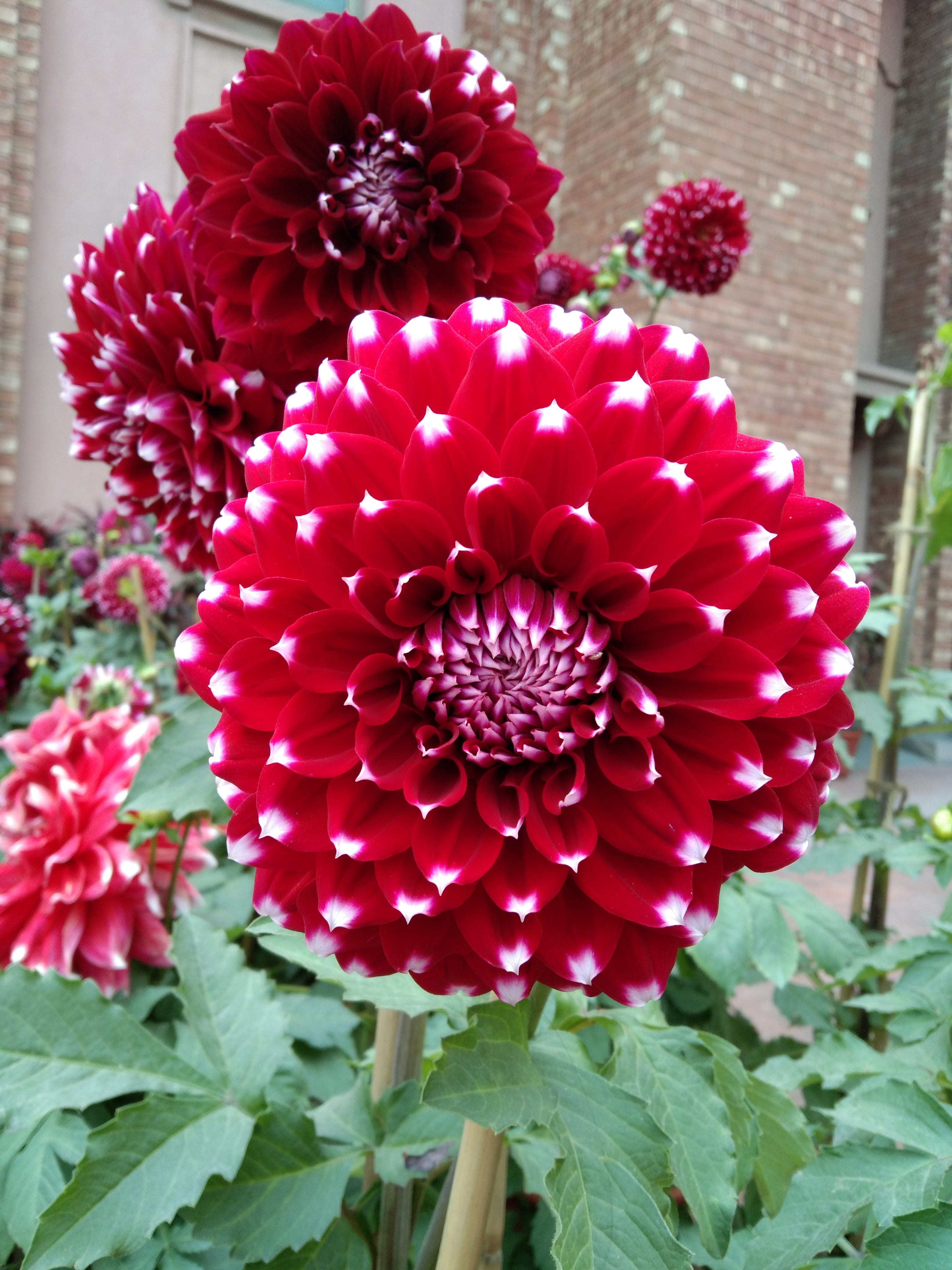
I love this activity because it helps me think better. Also, if you can’t plant a seed, you always have the option to go outside and see every flower. Think of the ways someone actually spent time caring for these beauties. Consider yourself one of those precious flowers that will help you grow slowly and beautifully. I love watching flowers. Not because flowers erase disappointment, but because they remind me that growth often happens where no one can see it.
Along with watering my plants, I learned to cherish the company of my budgies. They ask for so little, a few seeds, fresh water, and a little love. Yet they give so much in return. They never question my worth after a rejection or care whether a publisher said yes or no. They simply greet me with cheerful chirps, reminding me that love doesn't always need a reason. Sometimes, healing begins with caring for another living being, and in return, allowing yourself to be loved without conditions.
2. Jar method.
This one’s personally my favourite. Writing your manifestations and affirmations on a piece of paper and filling the jar helps whenever I’m struck with rejection. It helps me stay on track and helps me slow down, write, think, and ponder my goals once more.
Whenever I indulge in this activity, it helps me think about how important my goals are. Those goals mean the world to me, and I can’t let a mere email of rejection or a foul comment take my passion and goals away from me.
Simply slow down and take a piece of paper. I prefer coloured pages because they help me get a bit creative. I write what I manifest, my goals, my dreams, anything, even if it’s as simple as, “That rejection does not define me!” or anything that comes to mind. Let your hand move in a rhythm and let your mind finish the sentence. Sometimes, I even write poems about grief, scribbles, doodles, or even quotes I find on Pinterest. Sometimes, I write a funny joke that crosses my mind to lighten the mood.
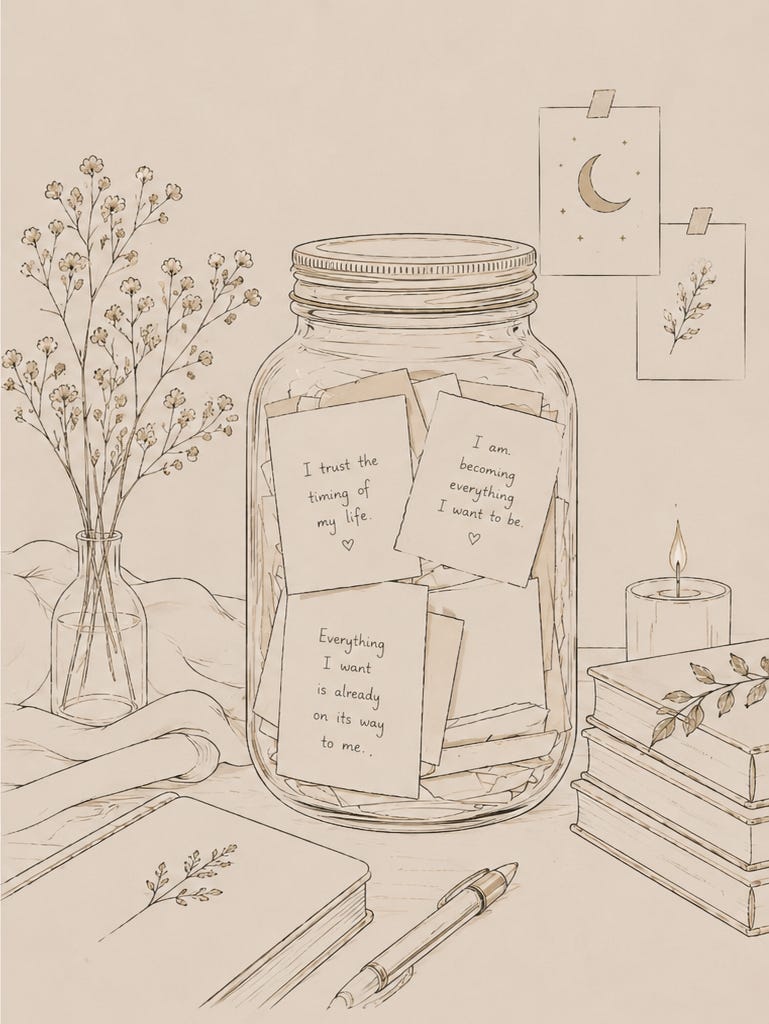
This activity prevents me from crying rivers of tears and actually helps me focus on how important my dreams are. You can always come back to the manifestation jar, open any folded page, and read your manifestation or affirmation out loud. This helps! If you don’t want to do the jar method, you can do the vision board method. Make a collage of all your goals. Take pictures from Pinterest, print out the collage, and paste it on a wall where you can see it. Tape it to your mirror or even put the collage as your wallpaper or lock screen. (I did this.) So whenever you open your phone, the first thing you see is your goals, and you subconsciously manifest them.
3. Keep writing.
When rejection makes me question my talent, I return to my notebook. Not because I suddenly feel inspired, but because writing is the only way I know to remind myself that my worth isn’t determined by someone else’s decision. Writing about my grief and collecting my thoughts on a piece of paper is what made me compile my poetry collection. One sentence. Then another. Eventually, a page. Then a chapter. That’s how I wrote two full-length novels, not by waiting for confidence, but by showing up anyway. Consistency is the key.
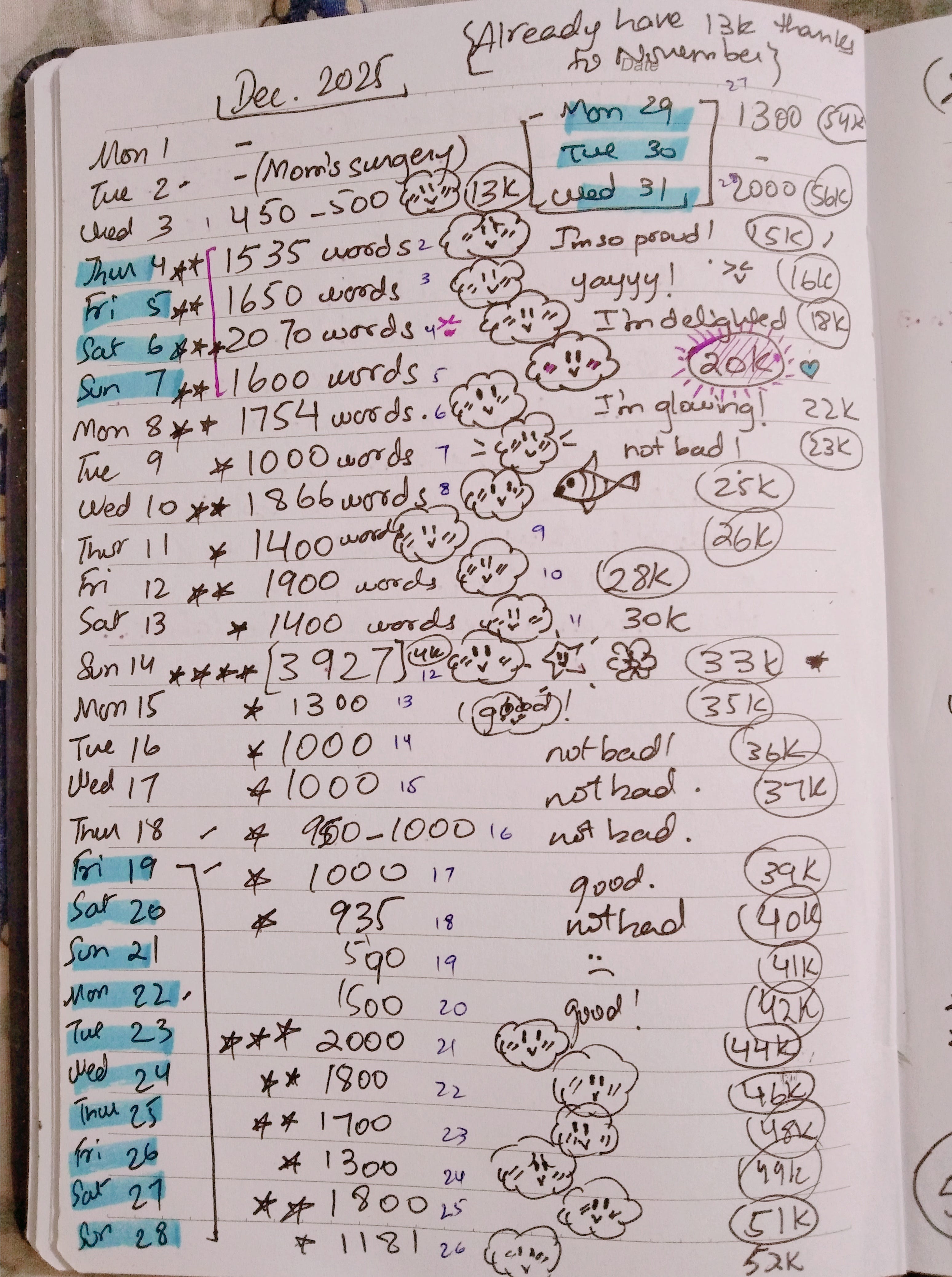
I recall making a checklist in my journal and writing the dates of every month, with a different section for each month, where I tracked my writing progress. I persistently challenged myself that I was going to write 1,000 words every day, and I’d be quite disappointed in myself on the days I skipped or wrote fewer than 1,000 words. I am truly hard on myself. Some days I’d write 3,000 words or even more! But showing up every day was what actually mattered to me.
I recall last December, when my mother had an eye operation. I was extremely stressed because I was managing the house, my studies, and writing my novel all at the same time. I was very hard on myself. I was so stressed that even my skin became worse because of the winter blues. But at the end of the day, from 10 p.m. to 12 a.m., I wrote consistently, no matter how difficult things were.
If you get rejected by a publisher or a journal and feel like your writing isn’t good enough, baby, you’re on the right track. Just take this as a sign from God that it means to write more! Yes, that’s exactly how I wrote my two full-length novels of 100,000 words and 130,000 words, respectively.
4. Remember that great writers were rejected too.
Rejection is not evidence that you should stop. It’s evidence that you’ve dared to try.
J.K. Rowling was rejected by numerous publishers before Harry Potter found a home.
Franz Kafka struggled to get his work published during his lifetime. He was considered ahead of his time, and many early publishers and critics simply did not understand his surreal, existential style. Because he was never satisfied with his own work, he ultimately ordered his friend and executor, Max Brod, to burn all of his unpublished manuscripts after his death. Brod famously ignored these instructions, ensuring Kafka’s literary immortality.
Stephen King threw the manuscript for Carrie into the bin after it received 30 rejections. His wife rescued it and encouraged him to keep going.
Beatrix Potter faced repeated publisher rejections before privately printing The Tale of Peter Rabbit.
Emily Dickinson saw very little of her poetry published during her lifetime, yet today she is considered one of the greatest poets in the English language.
History rarely remembers the rejection letters. It remembers the people who kept creating anyway.
Let rejection hurt, but don’t let it settle in. I no longer pretend rejection doesn’t sting. It does. I let myself feel disappointed. Then I make tea. Water my plants. Read poetry. Go for a walk. Play with pets. Sleep. (YES Sleep heals me!) Tomorrow deserves a version of me that hasn’t unpacked yesterday’s disappointment. Begin again. Every morning is permission to try once more. I’ve learned that resilience isn’t dramatic. It isn’t a motivational quote or a grand speech. Most days, resilience looks like opening your laptop. Picking up your pen. Watering your flowers. Writing 500 words. Trusting that today’s invisible effort will become tomorrow’s bloom.
The beautiful thing about rejection is that it has terrible eyesight. It mistakes potential for impossibility. It assumes today’s “no” is forever. It rarely is. Sometimes I think rejection has been my greatest teacher. It taught me patience, consistency. taught me to keep creating when no one was watching. Most importantly, it taught me that flowers never ask for permission to bloom. Neither should we.
P.S. If you enjoyed this piece, I hope you'll want to read my journey to becoming a writer and the poem that inspired the title of my first poetry collection.
With Love,
Dua ~xoxo
I'm Not Behind. I'm Becoming.

People often ask me if I’ve published a novel. The answer is no. What surprises them even more is that I have already written two novels and a poetry collection with over 100 poems. I have always felt an urge to write an article about my writing journey, what fascinates me about writing, and everything in between ever since I joined Substack four months…
The Poem That Named My First Poetry Collection

Every poetry collection has a poem that quietly becomes its center. It isn’t always the first poem written, or even the best one. Sometimes, it’s simply the poem that reveals what the entire book has been trying to say. Today, I’m going to share a poem that is very personal to me. It is the titular poem of my poetry collection. that poem is
loved this 🌷🌼🪻
"Our brain is fertile soil. It grows what we give it." That's the whole thing, isn't it — so much of what a rejection costs us is the weeds we plant in ourselves afterwards, without noticing. But you kept watering the things you actually wanted to grow. Two novels bloomed out of showing up at 10pm anyway. Thank you for the reminder that growth mostly happens where no one's watching. 🌸